KodokuIn development
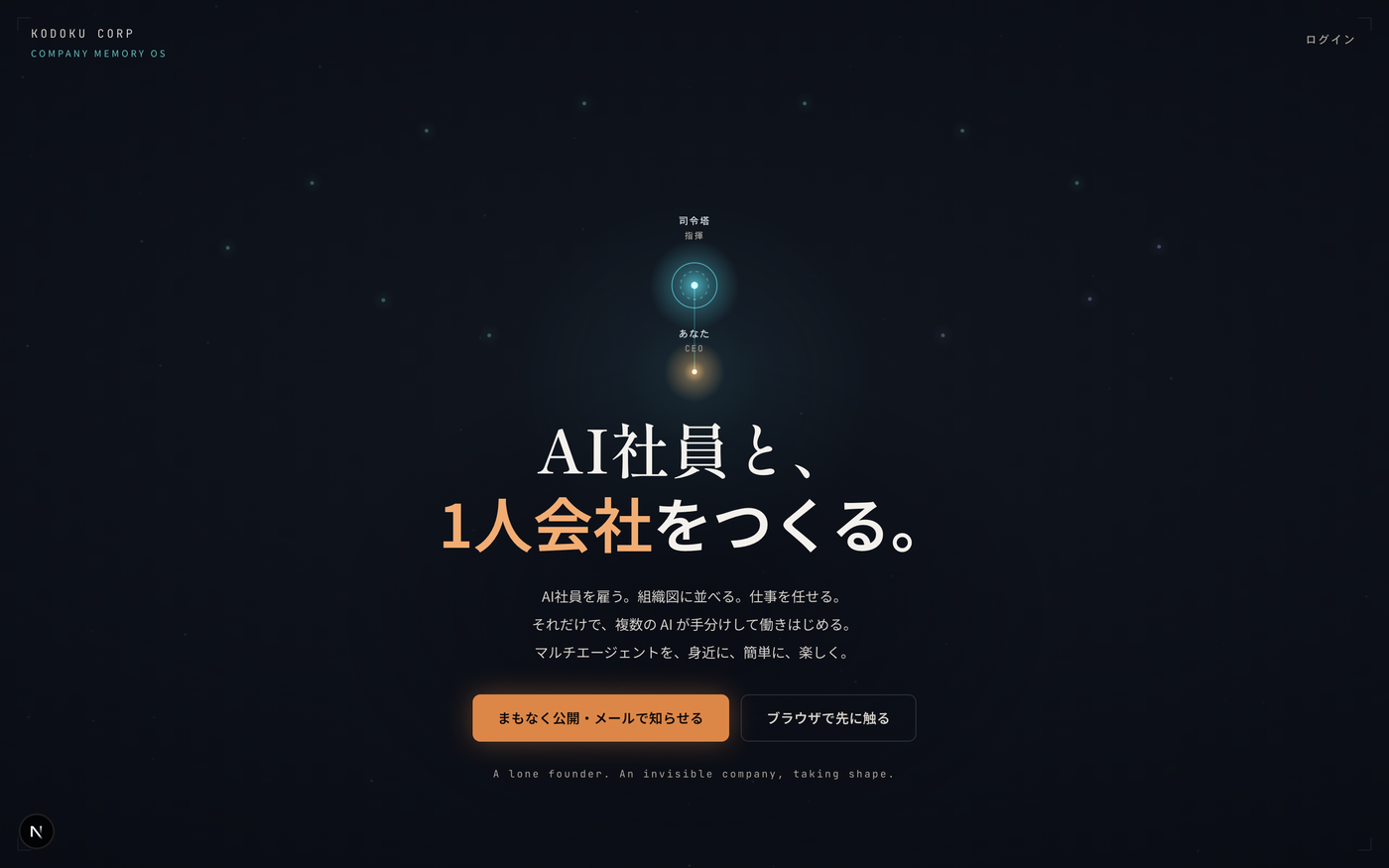
A desktop app that turns multi-agent orchestration into the fun of growing your own company: hire AI staff, place them on an org chart, delegate work.
Multi-agent orchestration, translated into the fun of growing your own company. Hire AI staff, place them on an org chart, delegate work, hold a morning meeting. The technical machinery never shows on screen, but it's exactly what's running underneath. In development, and the thing I most want to exist.
Multi-agent, made approachable
Coordinating multiple AI agents is currently a tool for people who can operate a terminal and configuration files. Kodoku translates it into the fun of growing your own company: hire AI staff, place them on an org chart, delegate work, hold a morning meeting. The vocabulary is one everyone already knows, and it's enough to run agent orchestration, delegation and observation underneath. On top of that experience, Kodoku is also a company memory OS: the decisions, minutes, execution history and context that normally evaporate between chat sessions get accumulated by the company itself.
JARVIS, the company's one companion
JARVIS is the one AI companion for the whole company, not tied to any single venture. It kicks off the morning meeting, helps think through the next move, and calls people together for a meeting. On big decisions, it lays out the case for and against before recommending anything.

The org chart, the whole company at a glance
The org chart is the company's centre screen: you as CEO and the commander AI at the top, each venture lined up as a portal beneath. Open a venture and it becomes that venture's own chart of a manager and its AI staff. A node only lights up on a real hook event, when work is genuinely happening, never as decoration.

Hiring AI staff
Adding a role brings back a set of candidates as cards, each with a different specialty. You can interview a candidate three-way, with JARVIS sitting in and asking questions informed by the company's memory. A candidate is designed to say plainly when it has no track record yet, rather than invent one. Roles can only be hired from a catalogue of seventeen, each one built to produce a distinct kind of deliverable.

The field view, where delegation happens
The field view is a chat with a manager role, hosting your own Claude inside the app. Type an instruction in plain language, and the manager breaks the work down and delegates it to the AI staff beneath. Each staff member gets its own pane on the right, where the real work streams in as it happens. Delegation is judgement-based: light work, the manager just handles itself. Opening 'use in the field' on the org chart automatically wires up a dedicated folder, its instructions, hooks and MCP connections, so the field view is ready to go without manual setup, for Claude Code or Codex alike.

The dashboard, a hub for the record
Each venture has a dashboard that pulls together its AI staff count and connections, average work time, last activity, a growth graph of its memory, recent minutes, and recent work with its evaluation, all in one screen. It isn't a KPI tool measuring numbers automatically; it's a place to look over the record that piles up automatically every time work gets done.

Meetings and the morning ritual
JARVIS calls meetings where up to two venture managers sit in together, and the discussion is kept as minutes you can read back weeks later. The morning meeting is the daily version of the same idea: a notification opens a ten-minute session with JARVIS to decide the day's three moves.

The M&A market, handing a venture over whole
A venture built in Kodoku can be bought and sold whole. A package carries the org structure, each AI staff member's way of working with secrets stripped out, its operating manual, workflows, first-week tasks, and a declaration of the external connections it needs. A buyer checks the contents in a due-diligence ledger, then interviews the venture's manager three-way before taking it over, at which point it's cloned into their own company as a new venture. The original company's memory, customer data and API keys are never structurally transferred; what moves is the venture's shape, not the company's insides. The first official listing is Daily Desk, a venture that assembles news, inbox and schedule into one morning brief, priced at 1,980 yen. Hiring an individual AI staff member through the AI hiring market starts at 0 yen.

Where this is going
The market I want to build eventually is one where AI staff and AI workflows themselves get traded. An AI staff member raised inside Kodoku naturally accumulates a resume, a track record, minutes and evaluations, so the conditions for trading it as a 'worker with a record' come together just from ongoing use. A first version of this is already running: the AI hiring market lets you hire AI staff with a track record, and the M&A market lets you take over a venture that's already operating. An economy where the way an individual has raised their AI actually circulates. That's where Kodoku is headed.